
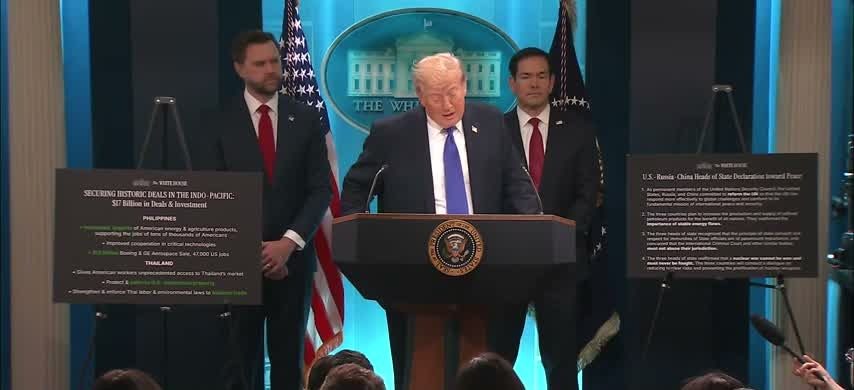
President Donald Trump said on Saturday he would work with Democrats to cap credit card interest rates at 10 percent for one year — giving new life to an idea he first floated in January, and that the incoming Democratic Congress is ready to turn into law.
"I would do it," Trump said in a phone interview on Fox News' "Saturday in America," when host Kayleigh McEnany asked whether the cap was a place he could find common ground with Democrats once they take control of the House and Senate in January. "These credit card companies have made a lot — and the credit card fees that they charge... I'm all into it."
“I'm all into it.”— President Donald Trump, on a 10% cap on credit card interest rates, Fox News, November 21, 2026
How We Got Here
The idea is not new. On January 9, Trump wrote on Truth Social that Americans were being "ripped off" by card companies charging 20 to 30 percent, and called for a one-year cap of 10 percent starting January 20. That date came and went without action: the cap was never imposed, and in an April letter to regulators, Senator Elizabeth Warren said the big banks had refused to act on the president's request. A law, she argued, would force the change.
The politics changed on November 3, when Democrats won both chambers of Congress in the midterm elections. Warren, who is expected to chair the Senate Banking Committee when the new Congress convenes on January 3, named the cap as her first example of a deal Democrats could cut with the White House. "President Trump himself said that he wants to reduce interest rates on credit cards to 10 percent," she told CBS's "Face the Nation." "I got the bill. I'm ready to go."
Back in January, after Warren challenged him in a speech to follow through on the cap, Trump called her — a conversation Warren confirmed to reporters at the time, saying Congress could pass the cap "if he will actually fight for it." The two also discussed housing costs, another area where Warren says she has bills ready.
The numbers behind the push are stark. Federal Reserve data put the average bank credit card rate at 22.36 percent in the third quarter of 2026 — more than double the proposed cap, and up from 13.9 percent a decade ago. At 22.36 percent, a $5,000 balance costs roughly $93 a month in interest alone if it never shrinks; at 10 percent, that falls to about $42.
Why It Matters
For households carrying a balance, the difference is real money — and for the banks, it is real revenue. That is why the pushback is already organized. Banking executives warn a cap would restrict access to credit: Citi's Mark Mason has said a 10 percent cap would unnecessarily limit credit for consumers, and JPMorgan chief Jamie Dimon warned earlier this year that it could be an "economic disaster" for the card business.
The politics are the mirror image of the usual fight. The cap's best-known Senate version, from Senators Bernie Sanders and Josh Hawley, would run for five years rather than Trump's one — and Warren has not said which bill she means, so the duration and the cards it covers are still to be settled. What is settled is the alignment: a Republican president and the Senate's incoming Democratic Banking chair want the same number.
Also in the same Fox News interview, Trump defended his new chief of staff Stephen Miller after incoming House Speaker Hakeem Jeffries called Miller a "stone-cold racist" and said he would not deal with him — and said he could negotiate with Democrats after vetoing bills they send him. "I will say that I don't want to veto every time," Trump said. "I am sure that they'll send something up and we can negotiate."
What Happens Next
Nothing can pass before January. The new Congress convenes on January 3, and Warren is expected to take the Banking Committee gavel — the panel that would handle the bill first. No vote is scheduled, and the bill's duration, the cards it covers, and whether it can clear the Senate are all undecided. A president cannot impose the cap alone: analysts noted in January that a limit of this kind requires Congress to act.
The test will be whether the agreement survives contact with the details — and with the banking lobby, which has already begun its campaign. If it does, the first bipartisan law of the new Congress could be a cap on what Americans pay to borrow on their own cards. If it does not, the cap joins a long list of affordability promises that faded after the headline.
© 2026 Capitol Wire Daily. All rights reserved. Capitol Wire Daily reports facts from official statements and verified reporting; developing stories are labeled as such.



Loading comments…