
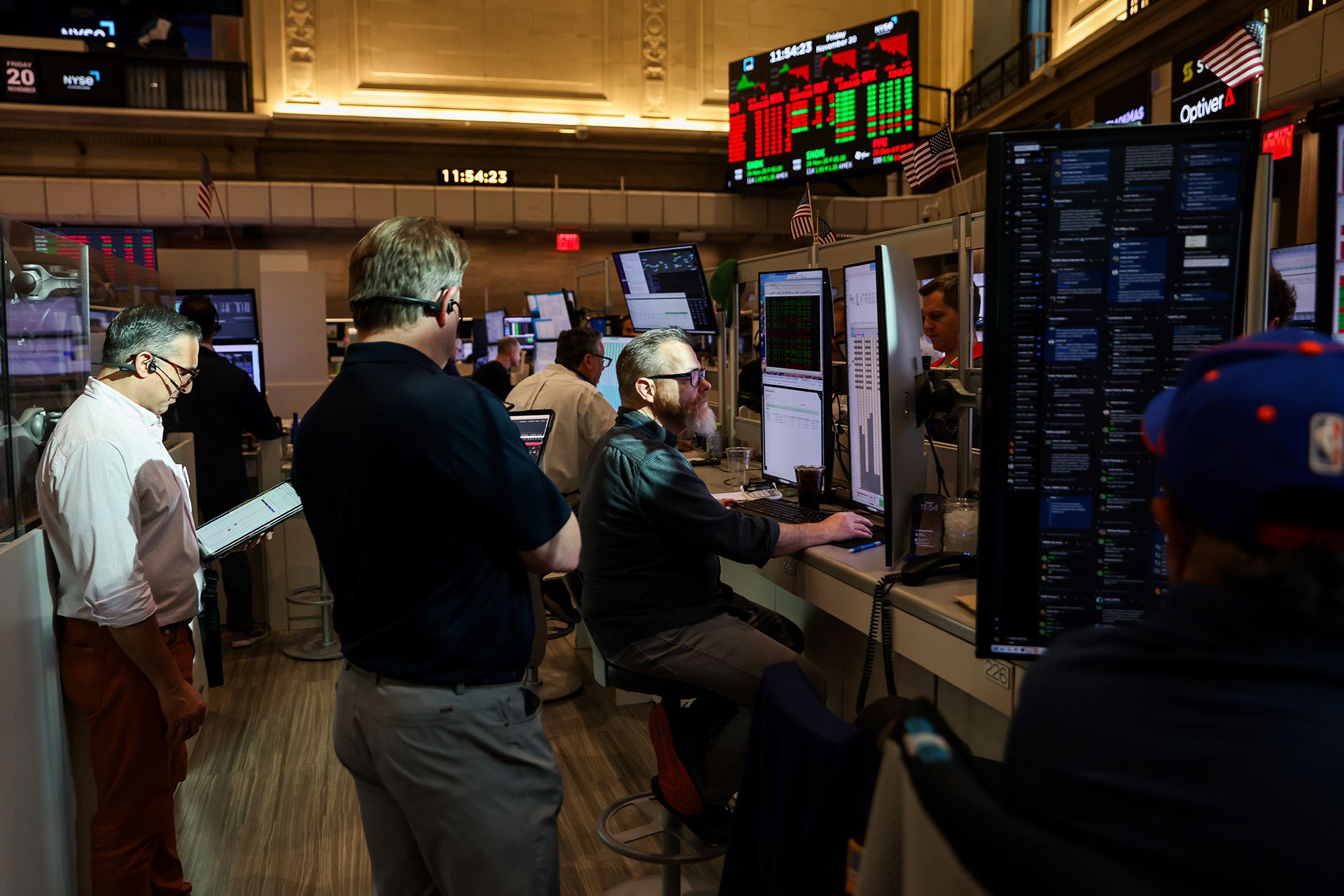
Wall Street closed one of its worst weeks since the pandemic on Friday, as a rout in artificial intelligence stocks wiped out the Nasdaq's gains for the entire year.
The tech-heavy Nasdaq Composite plunged 5.3% on Friday, the S&P 500 fell 3.7% for its seventh consecutive day of losses, and the Dow Jones Industrial Average dropped 950 points, or 1.9%. The Dow and the S&P 500 both closed in correction territory, down more than 10% from their recent peaks.
“The stock market is going through an AI repricing.”— Richard Saperstein, chief investment officer at Treasury Partners
The Details
The scale of the damage was historic. The Nasdaq lost 10% for the week, its biggest weekly decline since 2020, just past the spring 2025 tariff pullback. The S&P 500 fell 8.6% for the week and the Dow 8%.
More than $4 trillion in market value vanished from Nasdaq-listed companies in a single week. The Nasdaq is now down more than 2% for the year, having erased nearly 18% since its all-time high on October 6.
Wall Street's fear gauge, the VIX volatility index, soared 33% to 37. Investors piled into bonds, pushing the yield on the 10-year US Treasury note down 12 basis points to 4.93%.
Nvidia, the chipmaker at the centre of the AI boom, tumbled 14% on Friday and 23% for the week, its worst week since October 2008. The fall came after Reuters reported that the Securities and Exchange Commission is probing the company's accounting practices.
Anthropic, the AI lab behind the largest IPO in history, dropped 8.5% on its second day of trading, closing at $88.91 — barely above its $83 IPO price. The semiconductor index fell 11%, AMD dropped 13% after an investigation into its ties to Beijing, and CoreWeave, the Nvidia-backed cloud provider, slumped 12%.
How We Got Here
The sell-off caps a month of unraveling. AI stocks hit record highs as recently as last month, but the trade has been hit by a series of blows: the resignation of Nvidia chief executive Jensen Huang, questions over Chinese chip sales, and the Democratic Party's midterm win, which investors fear will slow data centre construction.
Interest rates have added to the pressure. The Federal Reserve is expected to raise rates in December, and possibly again in January, with the 10-year Treasury yield near 5%.
"The stock market is going through an AI repricing, reflecting an environment of slowing data center buildouts, reduced funding sources for AI-related projects and a slower trajectory of technology-related earnings growth," said Richard Saperstein of Treasury Partners. "This has been exacerbated by the Nvidia crisis and the Democratic midterm win, which were a one-two punch for the AI story."
Nvidia has now lost roughly 48% since its early-October peak, wiping out more than $2.8 trillion in market capitalisation in 45 days.
Both Sides Still Believe — Mostly
Even so, most investors interviewed by Reuters said they still believed in the AI trade. "In the short run, sentiment drives prices. In the long run, fundamentals do. Right now the market is selling first and asking questions later," said Michael Monaghan of Founder ETFs.
Gene Goldman of Cetera said the Anthropic IPO was a valuation test. "With the 10-year around 5% and the Fed still hiking, investors are asking how much of the AI story is already priced in," he said.
But the fear is spreading. "You have a growth fear because of the wealth destruction in the stock market, fears of moderation in AI spending, and fears that Nvidia problems will spread beyond Nvidia," said Jim Awad of Clearstead Advisors.
Why It Matters
A correction in the two broadest US indexes matters far beyond Wall Street. Retirement accounts, pension funds and the wealth effect that supports consumer spending all track the same benchmarks.
The AI boom has also driven US growth. If AI spending slows, growth slows with it — though slower growth could also cool inflation and mean the Fed raises rates less aggressively than markets price in.
What Happens Next
Traders will watch Monday's open for whether the selling continues or bargain hunters step in, as they did after the tariff shock in spring 2025. Mark Hackett of Nationwide said a capitulation washout "could ultimately prove constructive" and serve as the reset needed for a more sustainable rally into year-end.
The Federal Reserve's December meeting is now the next big test. So is Nvidia itself, still without a permanent chief executive while the SEC probe begins — and Anthropic, which has already given back almost all of its debut gains.

Loading comments…