
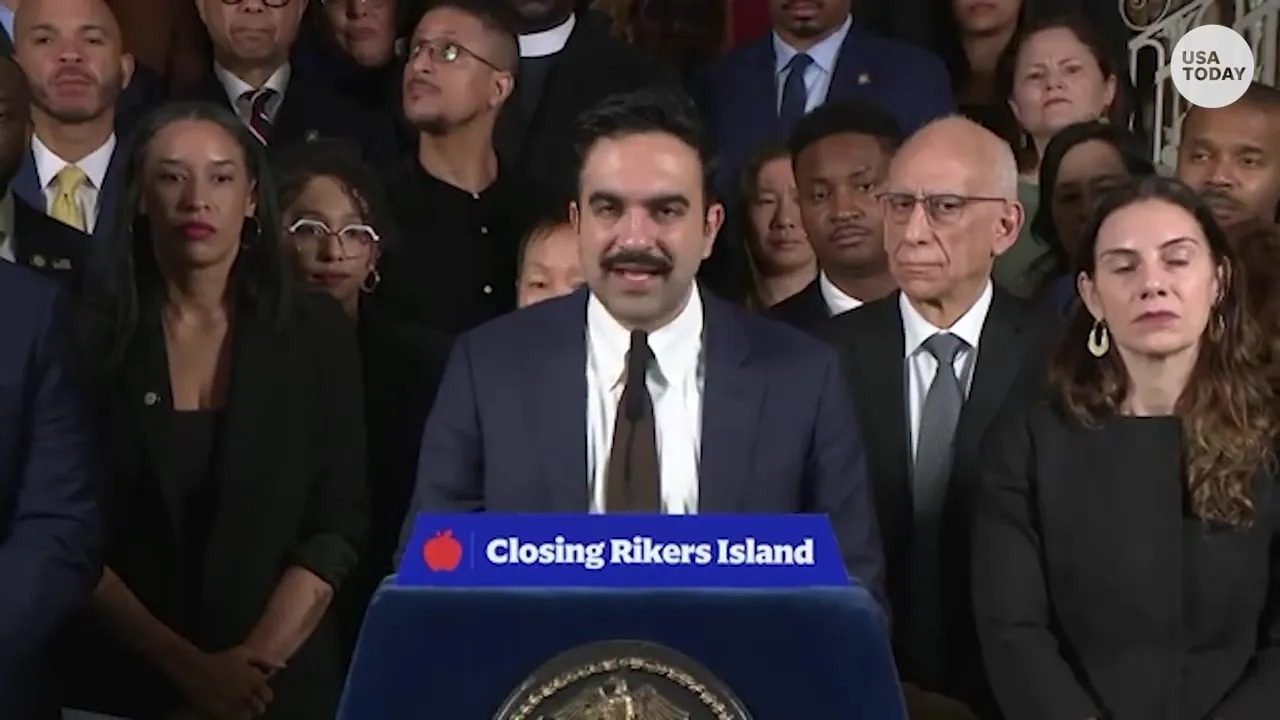
New York City Mayor Zohran Mamdani arrived at City Hall on Friday on crutches, sat on a stool beside the lectern, and unveiled his plan to close Rikers Island — the city's notorious jail complex — by 2032, five years after the deadline the law requires.
The plan would replace Rikers with four smaller jails in Brooklyn, the Bronx, Queens and Manhattan, cut the jail population from about 6,600 people to no more than 4,100, and invest $146 million next year in mental health care, substance-use treatment, education, job training and services for crime victims. The first new jail, in downtown Brooklyn, is scheduled to open in 2029; the Bronx and Queens facilities would follow in 2031, and Manhattan's in 2032.
How We Got Here
The 2032 date is itself the controversy. In 2019, the City Council voted to close Rikers and replace it with borough-based jails by August 2027, invoking the names of former prisoners who died there — including Kalief Browder, who was held at Rikers for three years as a teenager without trial and took his own life at 22. The city is now all but certain to miss that deadline.
Mamdani blamed his predecessor. He said the extended timeline was needed because of resistance from the previous administration, calling Rikers "a place we have long turned our eyes away from rather than confront head on." Former Mayor Eric Adams had opposed federal oversight of the jails and the borough-jail plan.
The jail's conditions are not in dispute. Rikers has been plagued for years by violence and overcrowding; a federal judge last year took control of the jail away from city officials and handed it to an independent remediation manager, citing conditions the judge called "abnormal and unacceptable." Dozens of people have died in custody over the past decade, and the complex records thousands of use-of-force incidents each year.
Mamdani said the closure plan was developed and would be carried out in consultation with that remediation manager. It also leans on the city's plan to cut the population: to 5,500 by the time the Brooklyn jail opens, and to 4,100 by 2032, including no more than 220 women. The tools are diversion and supervised-release programs, restored online bail payments, faster case processing, and expanded housing and social services. The plan adds 236 therapeutic beds in hospitals for incarcerated people with serious mental health needs, on top of 106 the administration has already opened.
“What will make this chapter different is our commitment to see it through, to chart a new path of public safety that endures, and to keep our promises where so many have been broken before.”— Mayor Zohran Mamdani, at City Hall on Friday
Why It Matters
The politics are as complicated as the logistics. The 2027 deadline is written into law, so the new 2032 timeline needs the City Council to amend it. The Council plans to introduce legislation to update the deadline, and Speaker Julie Menin backed the plan, saying the city must "bring this troubling chapter in our city's history to an end once and for all."
Critics have long argued the other side of the bargain. When the Council first voted to close Rikers, opponents said shrinking the jail population would mean more violent criminals on city streets — an argument that has shadowed every version of the plan since. The replacement jails have already cost $16 billion, according to the New York Post,
Mamdani framed the plan as a break with decades of promises. "Our nation has a very real mass incarceration problem," he said. "We are making a conscious decision to advance a new model of a criminal legal system in our city, one that takes on that problem head on." He announced the plan in a pre-recorded video alongside Correction Commissioner Stanley Richards — the first formerly incarcerated person to lead the department — who was once held at Rikers himself.
What Happens Next
The Council's vote on the new deadline is the first test. If it approves the delay, the timetable turns on the population cuts: the Brooklyn jail cannot open in 2029 unless the number of people in custody falls on schedule.
And then there is the mayor's own timetable. Mamdani tore his Achilles tendon on Thursday night, playing indoor soccer against the press corps — a non-contact injury, moments after he scored a goal and, in his words, "forgot that I was 35." He told reporters he had not stretched before the game. He will wear a boot for six to eight weeks and expects to be back on the pitch in about nine months — well before the first new jail opens.
For now, the promise stands: Rikers Island, open since the 1930s, is to close by 2032. Whether this chapter is different, as Mamdani insists, will be decided by a Council vote, a shrinking jail population — and a deadline five years further away than the law allows.
© 2026 Capitol Wire Daily. All rights reserved. Capitol Wire Daily reports facts from official statements and verified reporting; developing stories are labeled as such.


Loading comments…