
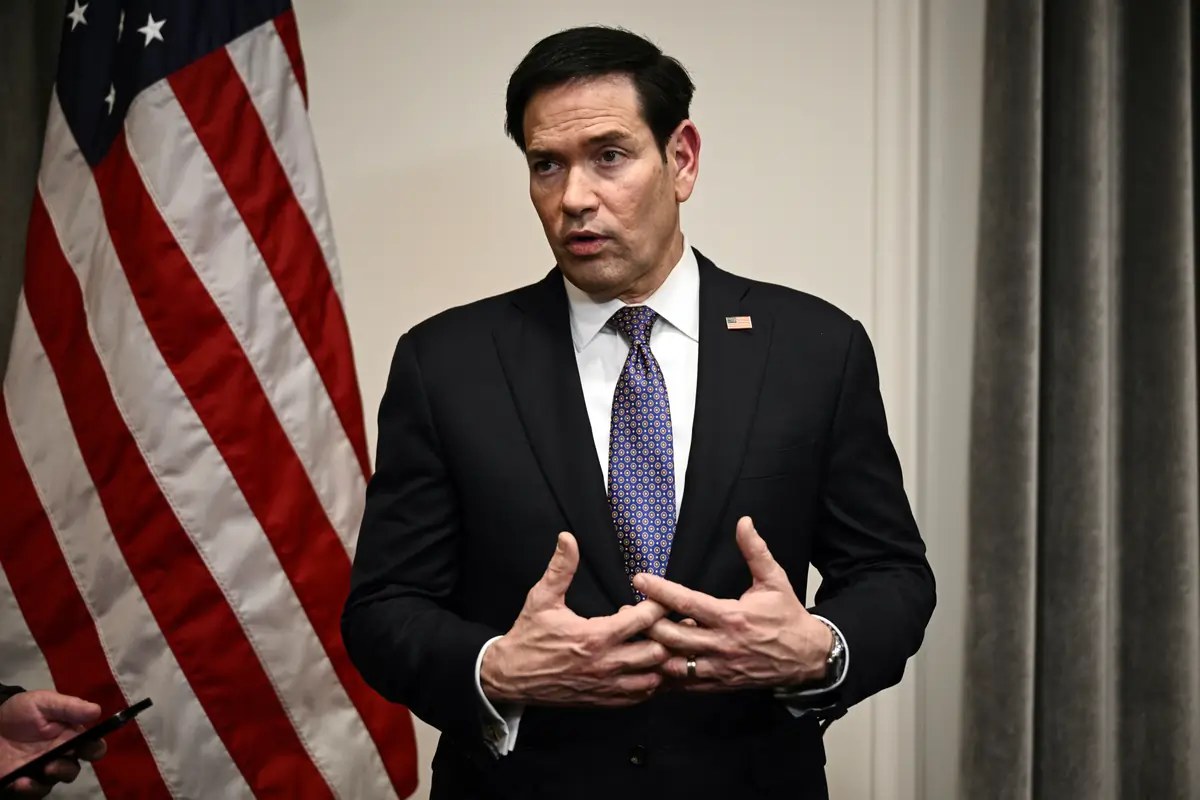
Marco Rubio has overtaken JD Vance as the first choice of Republican voters for the 2028 presidential nomination, according to the first major national poll taken since the midterm elections — a stunning reversal from a year ago, when Vance led the same survey by 48 points.
The Emerson College national poll, released on Thursday, found 36 percent of Republican primary voters naming Rubio when asked an open-ended question about whom they would support, against 20 percent for Vance. When voters were shown a list of candidates, Rubio's lead widened to 44 percent against 24 percent for Vance.
“I'll be one of the first people to support him.”— Marco Rubio, on JD Vance, to Vanity Fair last year
The Details
The survey was conducted from November 14 to 16 among 1,000 registered voters nationally, online and by text message, with a credibility interval of plus or minus three percentage points.
Behind the two frontrunners, Florida Governor Ron DeSantis drew 7 percent, as did President Donald Trump, barred by term limits from seeking another term, and Kentucky Representative Thomas Massie.
On the Democratic side, Georgia Senator Jon Ossoff leads the early field with 17 percent, ahead of New York Representative Alexandria Ocasio-Cortez at 12 percent and California Governor Gavin Newsom at 8 percent. In the closed-ended Democratic question, Ossoff held 17 percent, Harris 16 percent and Ocasio-Cortez 15 percent.
The poll also put Trump's approval at 37 percent against 54 percent disapproval, with the two parties' favourability ratings swapping places over the past year.
How We Got Here
A year ago, the same Emerson survey told a very different story. In November 2025, Vance led Rubio by 54 percent to 6 percent in the open-ended Republican question. The new result is the first time Rubio has led Vance in the Emerson series, and it lands after Republicans lost control of both chambers of Congress in the November 3 midterm elections.
Other polls tell a messier story. Rasmussen had Vance ahead 32 percent to 27 percent, Economist/YouGov put Vance up 41 percent to 34 percent, and Echelon Insights found Vance leading 40 percent to 26 percent. But Cygnal found Rubio ahead 34 percent to 31 percent, AtlasIntel had Rubio up 46 percent to 33 percent, and a Reuters/Ipsos poll last week also found Rubio leading. Prediction markets split the other way: Kalshi priced Vance at 31 percent and Rubio at 25 percent on Saturday.
The poll followed a week in which Trump put both men on public display. For 90 minutes on Friday, Vance and Rubio stood behind him in matching suits at a White House news conference, while Trump dodged a reporter's question about which would make a better president and joked that his new chief of staff, Stephen Miller, had outperformed them both. Vance also declined to say whether he would have ordered the February strikes on Iran, days after he publicly blamed the war for the Republicans' midterm losses.
Why It Matters
Trump has repeatedly declined to crown a successor, saying it is too early for an endorsement, while stoking the competition between the two men and even floating the idea that they could run together on one ticket. On Saturday, in a television interview, he described both as "doing fantastically" and "both very, very popular".
Yet the two men are in very different positions. Vance is widely expected to seek the nomination and has said he will decide sometime next year. Rubio has long signalled he has no plans to run, has said he would not challenge the vice president if Vance enters the race, and told Vanity Fair last year: "I'll be one of the first people to support him." Trump has also made Rubio's role as national security adviser permanent, deepening the secretary's foreign-policy profile.
For all the noise, the race is barely a race yet: no major contender has formally entered, and the first primary votes are more than a year away. But the Emerson numbers show the post-midterm field is no longer Vance's by default — and Rubio, an afterthought here a year ago, is now the name Republican voters give first.
What Happens Next
Vance has said he will discuss a possible 2028 run with Trump and decide sometime next year. Rubio's allies say he intends to stay at the State Department. The next round of national polling, after the new Congress takes office on January 3, will show whether Rubio's lead is the start of a real shift — or a post-midterm blip.

Loading comments…