
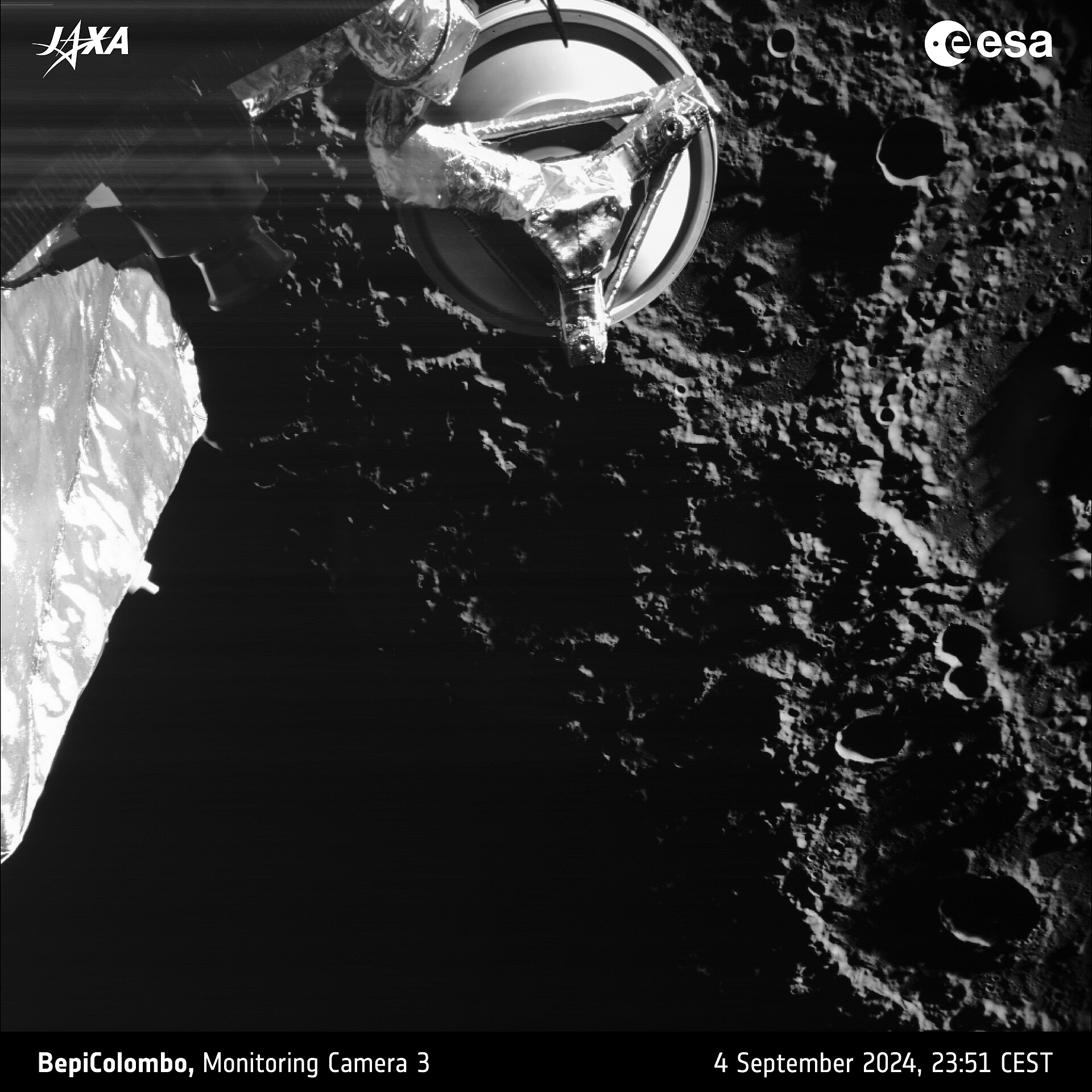
Europe and Japan's BepiColombo spacecraft slipped into orbit around Mercury on Saturday, eight years after it left Earth — becoming only the second mission ever to orbit the solar system's innermost planet.
The European Space Agency announced on November 21 that its Mercury Planetary Orbiter had fired its thrusters and been captured by Mercury's gravity, entering an initial elliptical orbit of 590 by 11,640 kilometres. The spacecraft approached on Mercury's night side, over the planet's south pole, and will now spend months lowering its orbit before science operations begin in April 2027.
The Details
BepiColombo is not one spacecraft but two. The European-built Mercury Planetary Orbiter and the Japanese-built Mio orbiter travelled to Mercury locked together, sheltered inside a sunshield, with a separate transfer module providing power and propulsion for the cruise. The two orbiters will separate from each other on December 9–10, making BepiColombo the first mission ever to fly two spacecraft around Mercury at the same time.
The Mercury Planetary Orbiter will then perform a series of burns to descend to its final science orbit by March 2027, flying between 400 and 1,500 kilometres above the surface. Mio will take up a more distant orbit to study Mercury's magnetic environment. Science operations for both spacecraft are set to begin on April 6, 2027.
The orbiter carries cameras, spectrometers, an altimeter and a radio science experiment, and will fly as close as 480 kilometres from Mercury's surface. That proximity matters: Mercury is a world of extremes, where solar radiation is ten times what Earth receives and temperatures swing violently between day and night.
How We Got Here
BepiColombo launched on October 20, 2018, and took the long way to Mercury — a looping, eight-year journey that used flybys of Earth, Venus and Mercury itself to bleed off speed. It completed its final Mercury flyby in January 2025, and its transfer module separated from the two science orbiters on September 3, 2026, beginning the arrival phase.
The journey nearly failed. In September 2024, a power-related anomaly limited the thrust of the spacecraft's solar electric propulsion system, forcing a redesign of the route and delaying arrival by almost a year. Engineers reworked the trajectory, and the mission arrived in November 2026 as planned — eight years and a month after launch.
Mercury has been orbited only once before, by NASA's MESSENGER, which circled the planet from 2011 to 2015. BepiColombo's twin-spacecraft design is meant to go further, studying the planet's magnetic field, surface and thin exosphere from two vantage points at once.
Why It Matters
Mercury is the least understood of the rocky planets. It is small, dense and strangely magnetic for its size, with a huge iron core and water ice hiding in permanently shadowed polar craters — despite sitting closer to the Sun than any other planet. How it formed that way is one of planetary science's open questions, and BepiColombo was built to answer it.
The mission also matters as a test of endurance. Surviving eight years in the inner solar system, recovering from a propulsion failure, and arriving on schedule is a technical achievement in its own right — and the data it returns over the next year will shape how scientists understand not just Mercury, but how rocky planets form around other stars.
What Happens Next
The two orbiters separate on December 9–10, when Mio deploys from the stack and unfurls its wire antennas and magnetometer masts. The sunshield protecting Mio comes off on December 16. Through the winter, the Mercury Planetary Orbiter will burn its way down to its science orbit, with commissioning continuing through March. If all goes to plan, the science phase opens on April 6, 2027 — more than eight years after launch, and the real work finally begins.


Loading comments…