
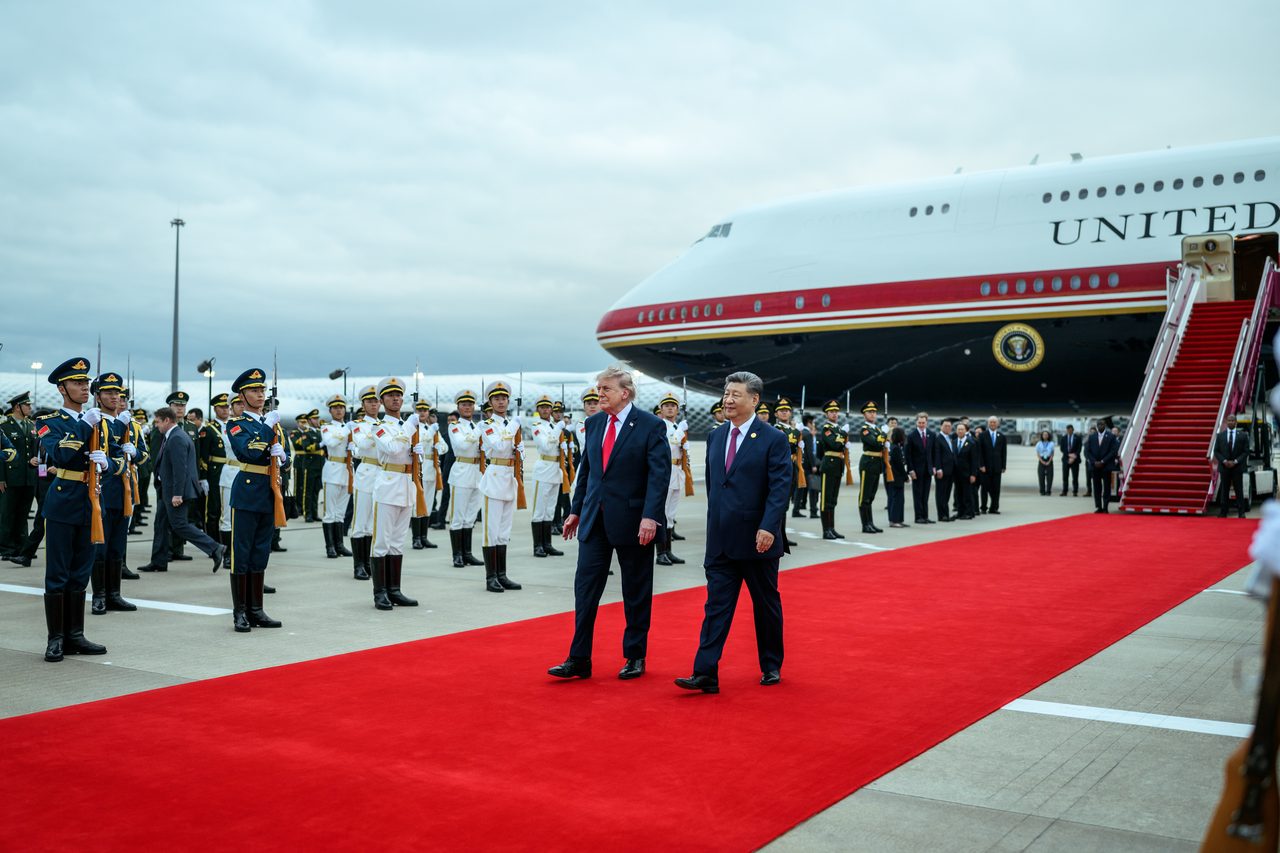
President Donald Trump and Chinese President Xi Jinping agreed on Thursday to extend the trade truce between the world's two largest economies, keeping a tariff war that once peaked at 145 percent on hold — though neither side has said for how long, or on what terms.
The agreement, reported by the Globe and Mail, CNBC and Bloomberg after the two leaders' bilateral meeting in Shenzhen, was the one concrete result of a day otherwise dominated by the first-ever trilateral with Russian President Vladimir Putin. Beijing's own readout of the Xi–Trump meeting mentioned no extension details, and the White House had not released a readout of the talks at the time of publication.
How We Got Here
The truce was struck in Busan, South Korea, in October 2025, after months of tit-for-tat escalation that pushed American tariffs on Chinese goods to 145 percent and Chinese tariffs on American goods to 125 percent. Trump agreed to trim tariffs in exchange for Beijing cracking down on fentanyl precursors, resuming soybean purchases and pausing rare-earth export controls.
The deal was extended to January 10, 2027, at a September summit in Washington, where the two sides also agreed to lower tariffs on a $60 billion batch of non-sensitive goods. But the bargain has been fraying: U.S. officials have repeatedly complained that China is not delivering rare earths at the expected volume and pace — a grievance Treasury Secretary Scott Bessent and U.S. Trade Representative Jamieson Greer raised with Chinese Vice Premier He Lifeng in a video call earlier this month.
The Shenzhen meeting was the third between Trump and Xi this year — after a May visit to Beijing and the September Washington summit — and it opened with unusual warmth. Xi personally greeted Trump on the tarmac when he landed on Wednesday, the first time in roughly 50 years that a Chinese leader has met a visiting dignitary at the airport.
A friendly meeting, an unresolved fight
Thursday's session at Kylin Villa, a lakeside government guesthouse, ran for more than an hour and stretched into an unannounced working lunch, delaying the trilateral with Putin by at least an hour. Xi called the talks "positive and constructive," and the two leaders agreed to build what Beijing's readout called a "constructive relationship of strategic stability" — and to draw up an action plan to stabilize relations, with greater cooperation on artificial intelligence and drug controls.
Trump called Xi a "friend" and credited a newly established U.S.–China Board of Trade with helping to rebalance what he called a "lopsided relationship." "We've made it a fair relationship — that's what we want," he said, describing the meetings as "incredible." He also pressed Xi to do more for American farmers, asking China to follow through on prior commitments on U.S. soybeans and agricultural products.
“We've made it a fair relationship — that's what we want.”— President Donald Trump, on his meeting with Xi Jinping in Shenzhen, Nov. 19
But the meeting took place under the shadow of a fresh fight. Earlier this week, the U.S. Commerce Department announced new measures aimed at preventing Chinese access to top AI chips — prompting a warning of retaliation from Beijing. The Chinese readout did not explicitly mention the curbs, and its account cited Trump sticking to the longstanding U.S. position that it does not support Taiwan's independence.
The two sides are also looking to advance tariff reductions on $30 billion worth of each other's imports, negotiated under the Board of Trade. But Reuters reported before the meeting that no new progress on mutual tariff reductions was expected to be announced in Shenzhen — and none was.
Why It Matters
For American businesses and farmers, the extension removes the most immediate threat: a January 10 deadline that would have snapped tariffs back toward the peaks of last year's trade war. For Trump, it is a deliverable from a trip that produced a four-point declaration with Xi and Putin but no deal on Ukraine, Iran or nuclear arms.
For China, the truce preserves access to the American market while the chip fight escalates. Washington's new curbs, if thoroughly enforced, could cut off a major source of computing power for Chinese AI development by restricting remote access to high-end chips hosted in overseas data centers — and Beijing has warned of countermeasures if the two sides cannot reach a resolution.
What Happens Next
The two leaders meet again at the G20 summit in Miami on December 14–15, their fourth meeting this year. Until then, the questions the extension leaves open — how long it runs, what it covers, and whether the chip curbs unravel it — will be answered by negotiators, not by the two men who shook hands in Shenzhen.
For now, the trade war is on ice. How thick the ice is, nobody in either capital is saying.
© 2026 Capitol Wire Daily. All rights reserved. Capitol Wire Daily reports facts from official statements and verified reporting; developing stories are labeled as such.



Loading comments…