
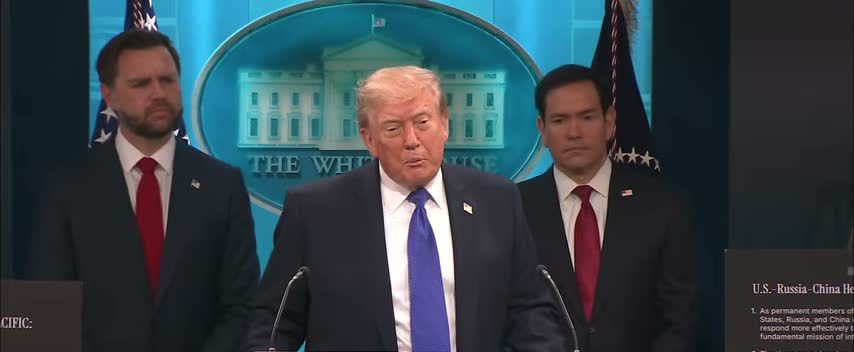
President Donald Trump said on Friday that American companies will face a "tremendous tax" if they build artificial intelligence data centers outside the United States — a warning he delivered at a White House news conference, then admitted he had not shared with his own officials first.
"We're not going to allow our companies to build data centers outside of our country," Trump said, flanked by Vice President JD Vance and Secretary of State Marco Rubio. "If they do that, they can, but we're going to put a tremendous tax on them if they do it." He named one project he intends to block: "They want to build now, one in Finland. And we're not allowing that to happen."
“We're not going to allow our companies to build data centers outside of our country.”— President Donald Trump, White House news conference, Nov. 20
How We Got Here
The warning came at the end of a four-day Asia trip — the Philippines and China, capped by Thursday's first-ever trilateral meeting with Xi Jinping and Vladimir Putin in Shenzhen — and at the start of a 90-minute news conference in the James S. Brady Press Briefing Room.
Trump framed the issue as a race with China over what his administration calls "super intelligence" rather than artificial intelligence. "China will take all of them, and we're not allowing that to happen," he said. "Whoever wins SI, wins."
The build-out is already global. Google has committed 13 billion euros to computing infrastructure in Finland, and Amazon Web Services announced plans last month to invest 18 billion euros in Germany next year, part of it for data-center capacity. Microsoft, Amazon, Google and OpenAI have pledged billions overseas, drawn by cheaper land, labor and electricity — and by permitting fights at home.
Washington moved in the same direction days earlier. On Monday, the Commerce Department closed a loophole that let Chinese firms rent AI computing power from data centers in Southeast Asia and elsewhere running on U.S. hardware; such facilities now need a U.S. license to supply large volumes of advanced-chip computing to companies headquartered in China.
And on Thursday, the Senate passed the Bipartisan American Affordability and Jobs Act 62–33, a permitting overhaul that makes data centers pay their own power costs. Trump praised the bill at the same news conference, saying it would put $1,300 a year back in Americans' pockets.
Why It Matters
The threat has no machinery behind it yet. No tax rate, no statute, no agency rule and no effective date appeared in the same-day coverage from AP, CNBC and Reuters, and Trump did not say which legal authority he would use. Any tax would be up to Congress — which is out for Thanksgiving week and does not return until November 30.
That gap matters because the stakes are concrete. Data centers are the physical backbone of the AI race, they consume vast amounts of electricity and water, and they have pushed power bills higher in communities across the United States — the same backlash that helped carry the permitting bill through the Senate.
Trump also used the briefing to say he and Xi had agreed to pursue joint guardrails on artificial intelligence — without publishing any text — and to tell communities hosting data centers to take advantage of them: "Make them pay you. Make them pay your community," he said. "But take advantage. Don't shut them off."
What Happens Next
No official response yet from the tech companies or from congressional leaders. The test now is whether the White House follows the threat with a proposal — a bill, an executive order or a Commerce Department rule — or whether it stays a line from a Friday news conference.
The next marker is Congress's return on November 30, and the December 11 government funding deadline, when the administration's leverage over spending — and Democrats' leverage over the Iran war — will be tested in the same negotiation. Until then, the "tremendous tax" exists as a warning, not a policy.
© 2026 Capitol Wire Daily. All rights reserved. Capitol Wire Daily reports facts from official statements and verified reporting; developing stories are labeled as such.

Loading comments…