
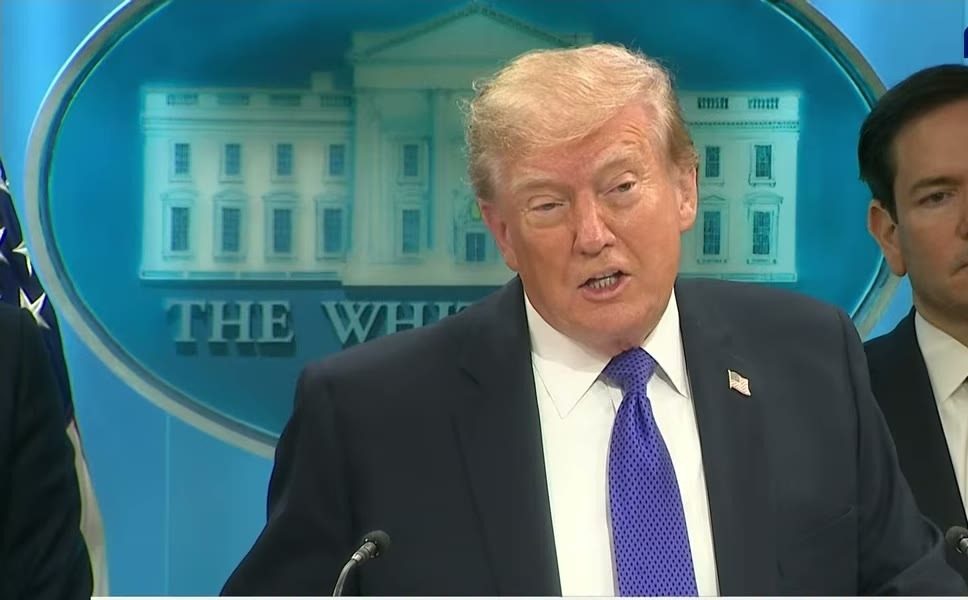
President Donald Trump said Friday that American companies that build data centers outside the United States will face a 'tremendous tax' — a threat he delivered at a White House news conference a day after returning from Asia, and one he said he had not told his own officials about before announcing it.
'We're not going to allow our companies to build data centers outside of our country,' Trump told reporters in the James S. Brady Press Briefing Room, flanked by Vice President JD Vance and Secretary of State Marco Rubio. 'We're not allowing data centers to go into other countries because China will take all of them, and we're not allowing that to happen. And we're going to put tremendous penalties on companies that try and do it.'
How We Got Here
The announcement was not planned. Trump said so himself — 'I don't know if that's a breaking story,' he told the room — and acknowledged he had not briefed his own staff. The conference, which ran nearly 90 minutes, was his first public appearance since returning Thursday from a three-day trip to the Philippines and China, where he met Chinese President Xi Jinping and Russian President Vladimir Putin in the first-ever trilateral meeting of the three leaders.
He named one project outright: Google's roughly €13 billion — about $15 billion — investment in data centers and artificial intelligence infrastructure in Finland, announced in September. Trump had already criticized the project on Truth Social. 'They want to build now one in Finland, and we're not allowing that to happen,' he said.
The companies have their reasons for looking abroad. Amazon, Google, Microsoft and OpenAI are pledging billions of dollars to build data centers outside the United States, drawn by cheaper land, labor and electricity — and by permitting battles and community opposition at home. Alphabet announced plans this month to invest $15 billion in data-center infrastructure in Malaysia in 2027 and 2028. Oracle and CoreWeave are also expanding overseas, and Southeast Asia has emerged as a major hub.
Trump framed the fight as both an economic and a strategic one. He said data-center construction was creating 'record numbers' of jobs at home, and told communities to welcome the building — and to charge for it. 'You have to take advantage of the data centers,' he said. 'Make them pay you. Make them pay your community.' And if companies will not build in Texas or California, he added, 'they're going to go in West Virginia.'
“We're not going to allow our companies to build data centers outside of our country. We're going to put a tremendous tax on them if they do it.”— President Donald Trump, at the White House on Friday
Why It Matters
For all its force, the threat has no details yet. Trump gave no tax rate, no timeline and no enforcement mechanism, and said nothing about which companies or projects it would cover. A new tax would need Congress — the president cannot impose one on his own — and no proposal has been published. It is not clear what lever the administration could pull unilaterally, though Trump has imposed tariffs before, some of which the courts have struck down.
Wall Street reacted as if the threat were real. Stocks fell after he spoke, and the Nasdaq Composite wiped out its gains for the year, closing a week that market watchers called the tech sector's worst since April. The Dow was down more than 300 points while the president was still at the podium, according to the market graphic carried live on C-SPAN.
The companies at the center of it have not answered. Google, Oracle and CoreWeave did not immediately respond to requests for comment on Friday, and no official response has come from the White House beyond the president's own words.
What Happens Next
Three things will show whether the threat becomes policy. First, whether the White House publishes an actual proposal — a rate, a start date, a list of what it covers. Second, how Congress reacts: a tax needs lawmakers, and the lame-duck session is already consumed by the December 11 funding deadline. Third, whether companies slow their overseas plans, or treat the remarks as the opening of a negotiation rather than a decision.
Trump also teased a second AI announcement from the same podium — a new agreement on international rules for artificial intelligence, which he said he and Xi had agreed to work on. For now, though, the data-center threat stands alone: a policy announced in a sentence, with no paper behind it, that still managed to move the market in an afternoon.
© 2026 Capitol Wire Daily. All rights reserved. Capitol Wire Daily reports facts from official statements and verified reporting; developing stories are labeled as such.

Loading comments…