
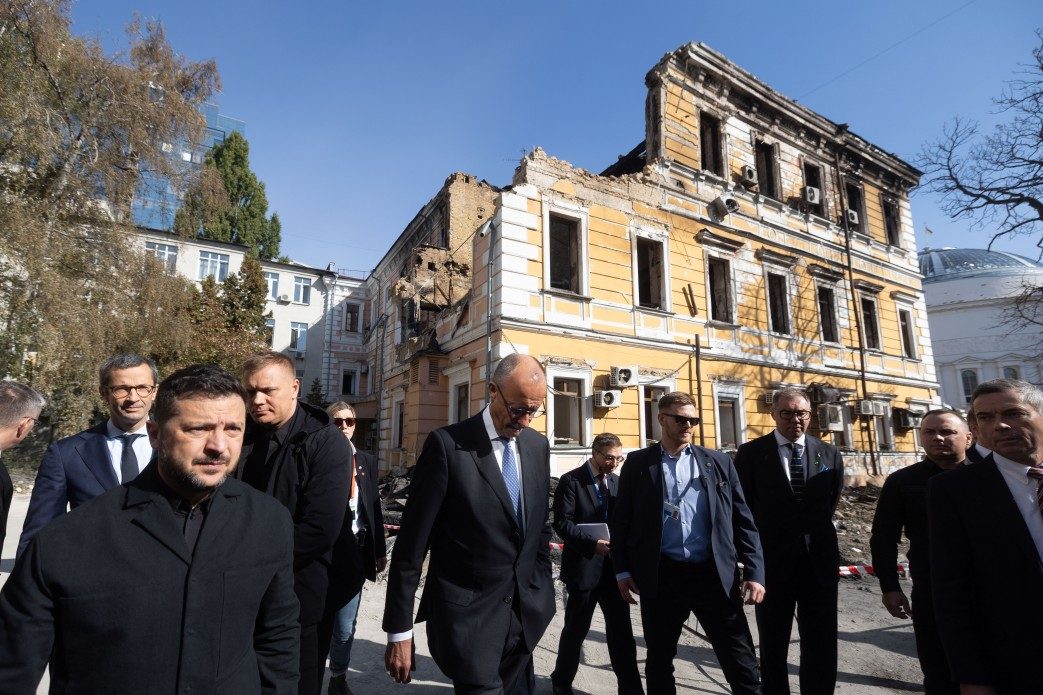
Ukrainian President Volodymyr Zelenskyy said on Saturday that President Donald Trump told European leaders this week they were spending a lot of money on the war in Ukraine — money they could use at home if a peace deal were reached with Russia.
Speaking to reporters in Kyiv before talks with British Defence Secretary Wes Streeting, Zelenskyy quoted Trump directly: "He said that Europe is spending a lot of money, and they could spend it on themselves after the end (of the war)." Then came the line that framed the whole day: "It didn't sound like a threat."
The call came on Thursday, hours after Trump wrapped up the first trilateral meeting of the leaders of the world's three largest nuclear powers — himself, Russian President Vladimir Putin and Chinese President Xi Jinping — in Shenzhen. From Air Force One, Trump dialed into the Coalition of the Willing meeting in Berlin, where some 40 delegations had gathered to pledge continued support. Politico, which first reported the call, said Trump questioned the billions in further aid and said Putin was serious about peace. The White House has disputed suggestions that Trump told the allies to stop funding Ukraine.
“It didn't sound like a threat.”— President Volodymyr Zelenskyy, Kyiv, November 21, 2026
How We Got Here
In Shenzhen, Trump, Putin and Xi signed a four-point Declaration Toward Peace committing the three countries to reforming the United Nations, keeping energy flowing and opening a dialogue on reducing nuclear risks — reaffirming that "a nuclear war cannot be won and must never be fought." The declaration did not mention Ukraine by name.
Back in Washington on Friday, Trump said Putin had "clearly expressed his desire to end the war in Ukraine by diplomatic means" during their talks. Zelenskyy said he was not convinced. "I'm a little bit more skeptical than Americans that he's ready for compromises," he said on Saturday. "That's what I said to the American team, by the way." Putin has shown no sign of dropping his demand that Ukraine surrender all of its eastern Donbas region — a demand Zelenskyy has rejected, noting the soldiers who have died defending it since Russia's invasion in 2022.
The peace process itself resumed only this month, after a nine-month hiatus, with talks in Abu Dhabi. Zelenskyy welcomed U.S. envoys' announcements that Europe would be a full partner — but said they now needed to agree on an agenda and a date for another round. "Certainly, America will try to make the meeting happen as soon as possible," he said. "And I am confident Russia will take all steps to slightly postpone such a meeting."
Why It Matters
The argument in Berlin was about more than tone. It was about who pays for the war, and for how long. The coalition reaffirmed €70 billion in military support for Ukraine this year — and at least the same amount in 2027. German Chancellor Friedrich Merz told reporters afterward: "We will continue to support Kyiv for as long as is necessary." Washington, meanwhile, is pushing for speed: the Financial Times reported Friday that the administration wants a deal by early January, before Democrats take control of Congress. Envoys Steve Witkoff and Jared Kushner conveyed that urgency in meetings in Moscow, Dublin and Berlin. "The Americans are pushing hard and there is a certain concern that many concessions would be needed from Ukraine to get closer to a deal," one European official said after meeting the envoys.
Kyiv feels the pressure in more than words. Zelenskyy said U.S. deliveries of Patriot interceptor missiles have fallen three- to fourfold this year, worsening a shortage as Russia intensifies its strikes. On Saturday he said Russia had again struck civilian targets overnight in his hometown of Kryvyi Rih, killing at least two people, including a seven-year-old boy. Streeting called a Russian violation of Polish airspace — which Polish authorities said was probably caused by two missiles and a drone — an "outrageous provocation," and urged allies to "do more to support Ukraine."
What Happens Next
Zelenskyy offered one concrete next step on Saturday: he said he was ready to attend the Group of 20 summit, which Trump is due to host in Miami next month, and that he would be happy to hold direct talks with Putin there. So far, he has not been invited. Trump has invited Putin to the summit; Putin has not yet said whether he will attend.
Congress returns from its Thanksgiving break on November 30, and Zelenskyy said on Saturday that he hopes the newly elected Congress will stay united in supporting Ukraine when it takes office in January. For now, the split is public: Washington pushing for a deal fast, Kyiv skeptical of Putin, Europe pledging money to keep Ukraine fighting from strength. The next test is whether the G20 produces a face-to-face between Zelenskyy and Putin — and whether the next round of talks gets a date.
© 2026 Capitol Wire Daily. All rights reserved. Capitol Wire Daily reports facts from official statements and verified reporting; developing stories are labeled as such.


Loading comments…