
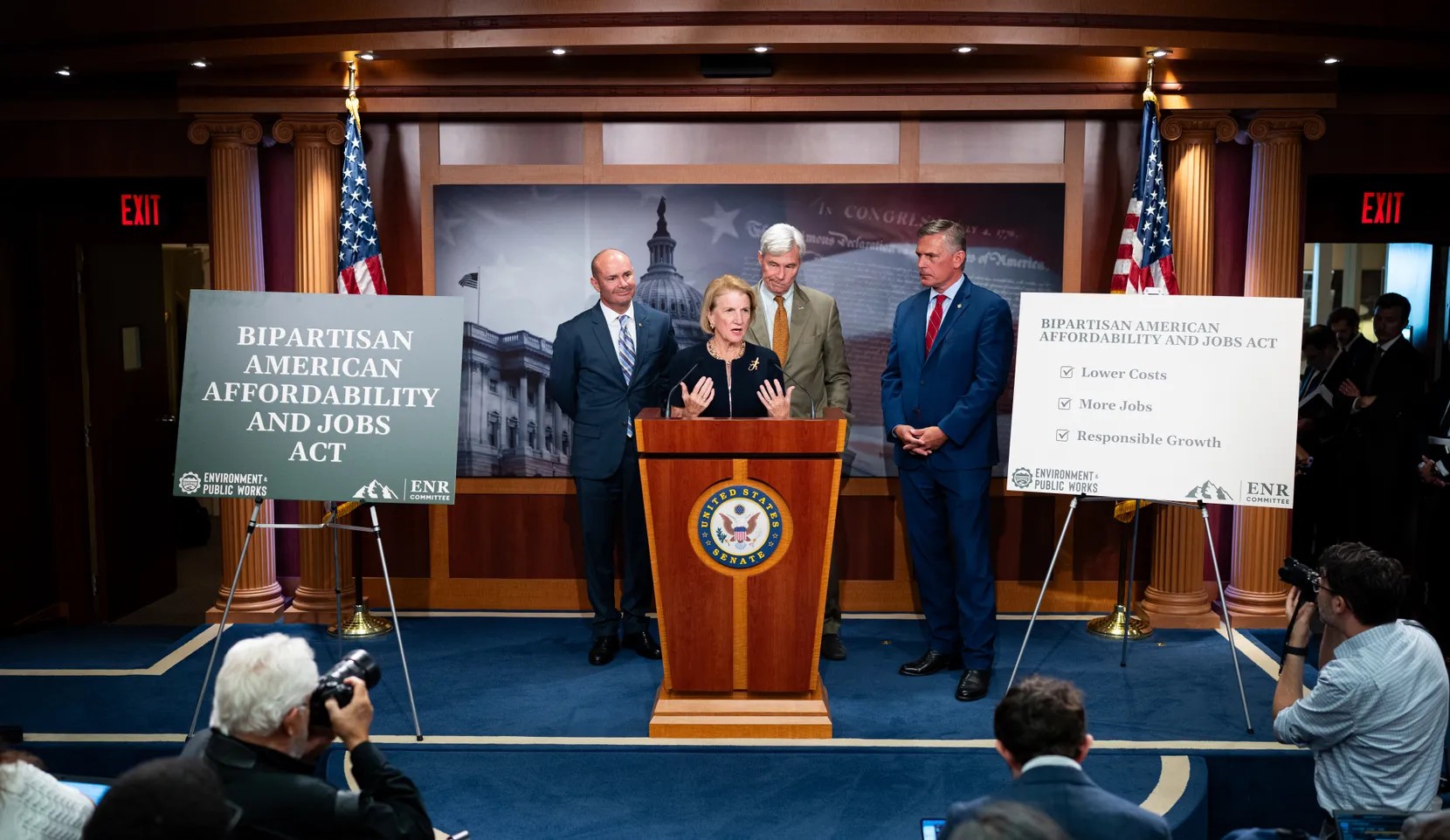
The Senate voted 62-33 on Thursday night to pass the Bipartisan American Affordability and Jobs Act, the sweeping energy permitting bill known as BAAJA, sending the 500-page package to the Republican-controlled House. If the House passes it, President Donald Trump has said he will sign it into law.
The vote marks Congress' most significant effort in years to ease the permitting bottlenecks blamed for rising energy costs — the product of a bipartisan compromise negotiated with the White House, after a final day of delay as two Oregon senators held up the vote over blocked amendments.
“BAAJA lowers costs and lowers emissions. It's that simple.”— Rep. Scott Peters (D-CA)
The Details
The bill would speed federal approvals for power plants, transmission lines, mines and data centers, setting deadlines for reviews under the National Environmental Policy Act and other laws, narrowing that act with the Clean Water Act and the Endangered Species Act, and limiting court challenges and the power of agencies to revoke existing permits.
New data centers using 20 megawatts or more would have to pay the full incremental cost of the grid infrastructure built to serve them, with financial guarantees and a bill for unpaid costs if they leave.
The 62-33 tally was three votes slimmer than Wednesday's 65-31 vote to end debate. The final vote had been expected around mid-morning, but Senators Jeff Merkley and Ron Wyden of Oregon held it up over blocked amendments, including one to ban data centers on public lands, and it finally came on Thursday night.
The bill reached the floor without a single committee hearing, written in secret, released on September 30 and inserted into an unrelated tax bill, H.R. 2347, as its vehicle.
How We Got Here
BAAJA took five roll calls in ten days to cross the Senate: 73-25 on November 9, 62-21 the next day, 70-27 on November 16, then 69-27 and 65-31 on November 18, before Thursday's 62-33 final vote.
Its authors are Shelley Moore Capito and Mike Lee for the Republicans, and Sheldon Whitehouse and Martin Heinrich for the Democrats. When the bill was introduced in September, Capito called it "a major step" toward faster building "without giving up any of the strong protections for our environment."
The Two Sides
Representative Scott Peters, a California Democrat whose own permitting bills are folded into the package, called it "the largest permitting reform package in history." Whitehouse said Democrats were "focused on lowering energy costs, reducing emissions, and stopping data centers' free ride." Supporters cite a Rhodium analysis finding median household electricity costs would fall from $2,200 a year to $2,134 by 2035.
Critics call that saving trivial — roughly the cost of one cup of coffee a month. The Western Environmental Law Center called the vote "the most damaging environmental and community protection rollback in American history," saying it would effectively repeal the National Environmental Policy Act and the Historic Preservation Act and weaken clean water and endangered species protections. The Sierra Club said the bill passed "following little debate and an insufficient amendment process" and urged the House to reject it. An Earthjustice poll found 77 percent of voters would rather keep existing environmental laws even if some projects take longer to build.
The tribal provisions were a running sore. Peters faulted two senators who, he said, blocked last-minute bipartisan amendments meant to improve the bill for tribal partners.
Why It Matters
Everything now turns on the House and the calendar: the bill must pass the same text before the current Congress ends on January 3, or it dies and the next Congress starts over.
House Speaker Mike Johnson supports the proposal and has predicted it could win enough votes, and Majority Leader Steve Scalise said there was still "a great chance" of getting a bill to the president's desk. But Minority Leader Hakeem Jeffries has called for changes, and Natural Resources Chairman Bruce Westerman doubted there would be time to revise the bill before the term ends. Senate Majority Leader John Thune urged the House to pass the measure as it stands: "It's been through the full monty when it comes to the legislating process."
What Happens Next
House leaders will now decide whether to bring the Senate text to the floor. If the House passes it unchanged, it goes to the president's desk; if the House amends it, the bill returns to the Senate with the clock running out. Peters urged House leaders to bring it to the floor "as soon as possible" so it can reach the president's desk "before this Congress ends."



Loading comments…