
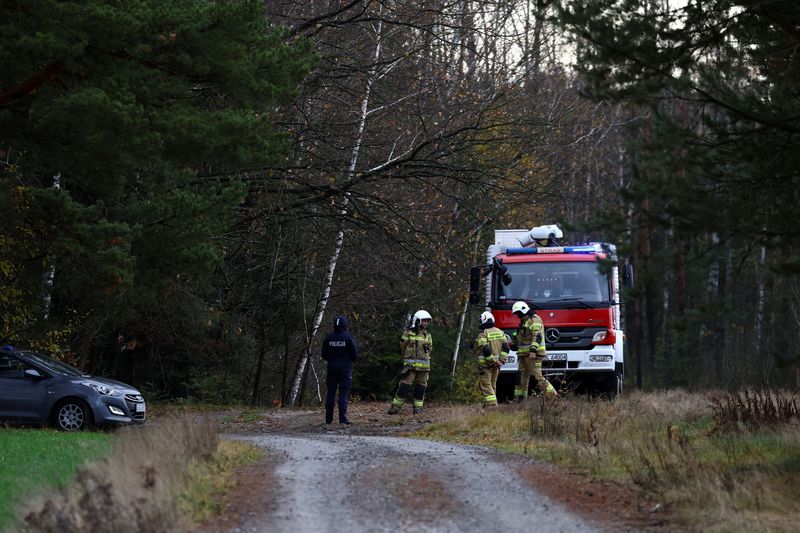
Poland says a Russian cruise missile crashed on its soil overnight. The Defence Minister confirmed on Friday that the object that fell in a field in eastern Poland was a Russian Kh-101, and called the incursion "another Russian provocation".
No one was hurt. The missile came down in open ground near the village of Nowy Lipowiec, a few hundred metres from the nearest homes, and was still burning when emergency services reached it. Two more objects came down in south-eastern Poland in the same night: a second missile and what the minister said was most likely a jet-powered drone.
“There has been a violation of Polish airspace and an incursion by objects from the Russian Federation.”— Władysław Kosiniak-Kamysz, Polish defence minister
The Details
The three objects crossed into Polish airspace during a large Russian drone and missile attack on Ukraine overnight. Polish radar picked up the possible violations after 06:30, and the first object struck the ground at about 06:35. Defence Minister Władysław Kosiniak-Kamysz said the first object was a Kh-101 missile, the second was also a missile, and the third was most likely a jet-powered drone.
He named the three sites: Nowy Lipowiec in Biłgoraj county, Rudnik nad Sanem in the Subcarpathian region, and Mołodycz in Jarosław county. At Mołodycz, metal debris was scattered over a wide area and a crater was left in the ground. At Rudnik nad Sanem, the object fell in a forest.
Prosecutors in Lublin confirmed the fall at Nowy Lipowiec on Friday morning. The area has been sealed off, and the military prosecutor's office is investigating alongside the Military Police and the Military Counterintelligence Service.
Air-raid alerts were issued in the morning for the Lublin and Subcarpathian regions, which border Ukraine, and lifted later that morning. The control tower at Rzeszów-Jasionka airport was evacuated, and some trains in the Subcarpathian region were stopped as a precaution. Polish and allied military aircraft were scrambled overnight, and ground-based air defences were activated.
How We Got Here
This is not the first time Russian weapons have crossed into Polish airspace. In September 2025, Russian drones entered Poland during an attack on Ukraine and were shot down by Polish and allied jets. Chmielek, near where the missile fell, lies about 45 kilometres from the Ukrainian border.
The timing was pointed. Friday was the day Poland was due to host military exercises of the "Coalition of the Willing", the group of Ukraine's allies, with defence ministers from France, the United Kingdom and the Baltic states in attendance, along with eight chiefs of staff. The minister said the convergence of the incursion with the exercises "is no accident".
Prime Minister Donald Tusk confirmed the airspace violation on Friday morning and said there was currently no threat from the air. He convened an emergency meeting with ministers, the armed forces and the heads of the security services.
Why It Matters
Poland is a NATO member, and a Russian missile landing on its territory is the kind of incident the alliance was built to deter. The minister's word — "provocation" — is his characterisation, not proof of intent: Moscow has not commented, and it is not yet clear whether the missile was aimed at Poland or went astray during the attack on Ukraine.
The two leaders who have spoken most directly about the incident do not agree. Tusk said the incursion looked like an intentional provocation, pointing to the exercises under way at Nowa Dęba — though he stressed the link remained a hypothesis. President Donald Trump, by contrast, called the incursion a likely "mistake". That split matters: it shapes whether the incident is treated as a deliberate test of NATO or as an accident of war.
Warsaw's response so far has been measured. There is no talk of retaliation. Instead, Kosiniak-Kamysz said Poland would ask NATO for more support in securing the alliance's eastern flank.
What Happens Next
The reassurance came on Saturday, when NATO Secretary General Mark Rutte flew to Warsaw and met Tusk. "I can guarantee that NATO will defend every inch of Polish territory," Rutte said, according to the Polish Press Agency, adding that "all allies stand in full solidarity with Poland". General Alexus Grynkewich, the head of NATO forces in Europe, would do everything necessary to identify threats and adjust deterrence, Rutte said.
On Monday, NATO's North Atlantic Council will meet in Brussels to discuss the violation. Investigators will keep working through the debris at all three sites. The world will be watching for Moscow's response — and for whether NATO answers Warsaw's request for more support.


Loading comments…