
The Kremlin said on Monday that Russia would keep up large-scale strikes on Ukraine, its first response after Kyiv claimed drone attacks on Russian ships off Libya and in the Baltic Sea over the weekend.
Asked whether Moscow would retaliate for the attacks of the previous 48 hours, Kremlin spokesman Dmitry Peskov told reporters that Russian forces were carrying out "large-scale, comprehensive strikes on military infrastructure in Ukraine" every day. "And this practice has very, very painful consequences for the Kyiv regime," he said.
“And this practice has very, very painful consequences for the Kyiv regime.”— Dmitry Peskov, Kremlin spokesman
Peskov declined to comment directly on Zelenskyy's claim that Ukrainian naval drones sank the Merkury in Benghazi on Sunday. "Our defense ministry is dealing with this," he said. "But of course we have taken note of Zelensky's statement." The Russian defense ministry has not confirmed the loss of the ship.
The Details
On the Baltic, where the Russian cargo ship Sparta II was set on fire by drones on Saturday while sailing to Kaliningrad, Peskov described "a very dangerous trend of expanding terrorist activity" in the region. He said it was raising tensions and that Moscow hoped Baltic states would use their influence on Kyiv to warn it against continuing.
Russia's ambassador to Libya, Aydar Aganin, called the attacks terrorist in nature and said Moscow would not leave them unanswered.
Musa al-Koni, deputy head of the Tripoli-based Presidential Council, held Ukraine "fully responsible" for the strikes and said they were "tantamount to a declaration of war on the Libyan state," according to RIA Novosti. He said civilians had been hurt and that Libya would take diplomatic steps.
The eastern-based government, which controls Benghazi, has asked the U.N. secretary-general and the Security Council for an international investigation. Its prime minister, Osama Hammad, asked Kyiv for "formal explanations."
The U.N. Support Mission in Libya called for "an immediate, independent and transparent investigation."
Albania rejected suggestions that the attack had been launched from its territory, saying the allegations had been made "without verifiable evidence."
How We Got Here
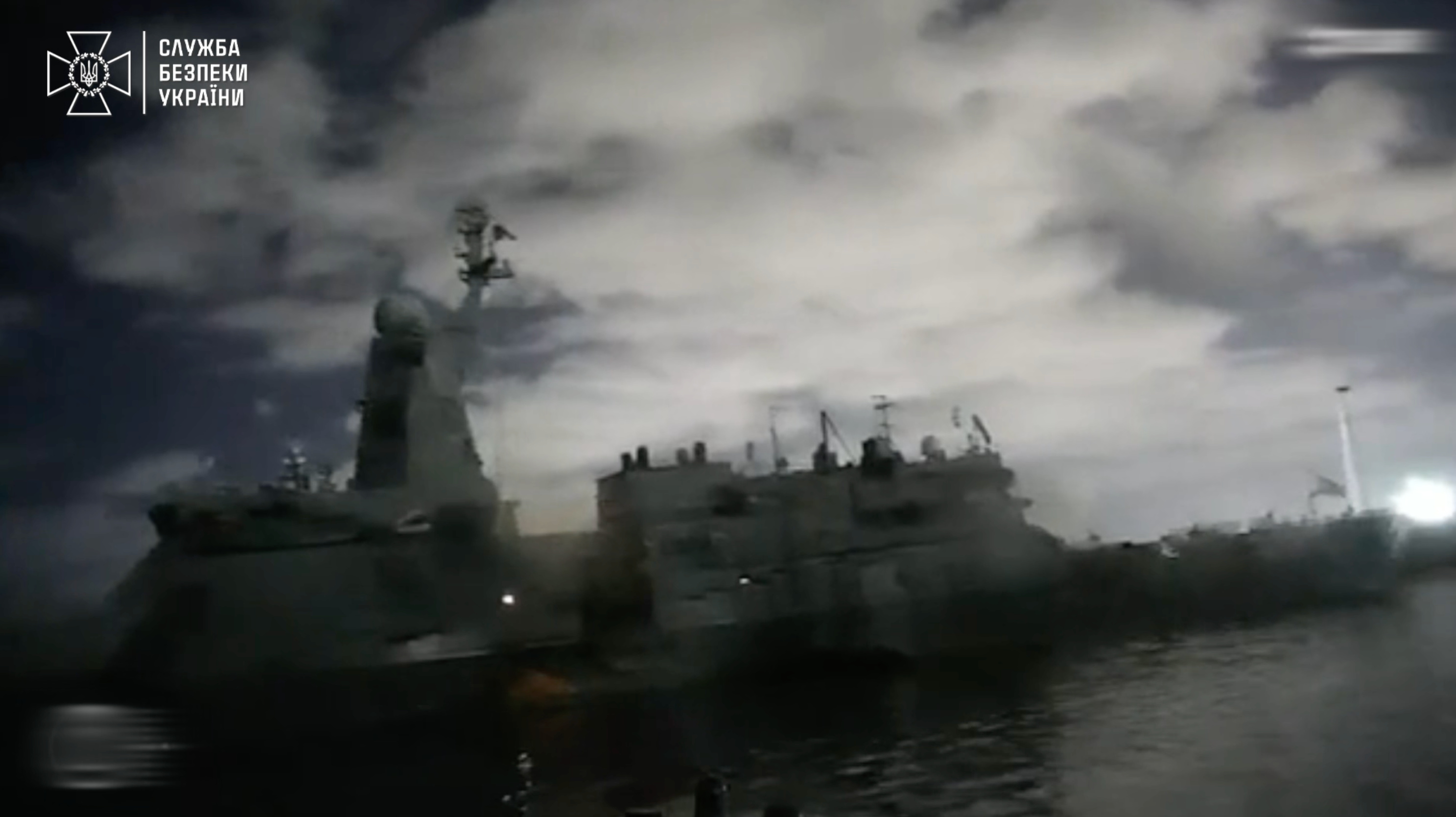
Zelenskyy said on Monday that Ukrainian forces sank the 344-foot corvette Merkury with seven Ukrainian-made naval drones, in Kyiv's first strike on Russian naval assets in the Mediterranean. A Russian Ka-27 combat helicopter was also destroyed along with the ship, and the Russian dry cargo vessel MV Angara was hit. At least 10 people, including Libyans and Russians, were wounded.
The Security Service of Ukraine, the SBU, published video of the operation on Monday and said the seven drone boats had been carried to the area and launched from a "mother ship." It said the Merkury, hull number 734, belonged to Russia's Black Sea Fleet.
The 1,800-ton Merkury was in Benghazi to refuel under a maritime cooperation agreement before it intended to return to Russia. It joined the fleet in May 2023.
A day earlier, a suspected Ukrainian drone strike set fire to the Sparta II in the Gulf of Finland. The Merkury joins some 40 other Russian naval vessels lost in the war, including the cruiser Moskva, sunk in April 2022.
A Ukrainian naval drone operator in Libya told CNN: "We are doing what we can. And we can (do) a lot."
Why It Matters
The weekend's attacks show the war spilling far beyond the Black Sea — into the Mediterranean and the Baltic — and dragging in countries that had tried to stay out of it. Russia uses ports and air bases in eastern Libya to supply its forces in Africa and the Mediterranean.
Protecting ships in foreign ports is difficult for any navy, analyst Carl Schuster told CNN. "When a warship is in a foreign port, the host country is responsible for the ship's physical security and protection," he said. Ukraine has a large merchant fleet that can "provide a lot of seemingly innocent launch platforms" for such attacks, he added. "We are looking at a new era of maritime unconventional warfare," Schuster said.
What Happens Next
The Russian defense ministry has yet to say anything, and the joint investigation launched by the eastern Libyan government and Russia is still under way.
For now, the sharpest signal is Peskov's: the strikes on Ukraine will continue, every day. Zelenskyy said on Monday that Ukraine was ready for four-way talks with Russia, the United States and Europe, and that partners wanted them to take place before Christmas. Peskov said Moscow was still working on the basis that Abu Dhabi would host the next round, but gave no date.


Loading comments…