
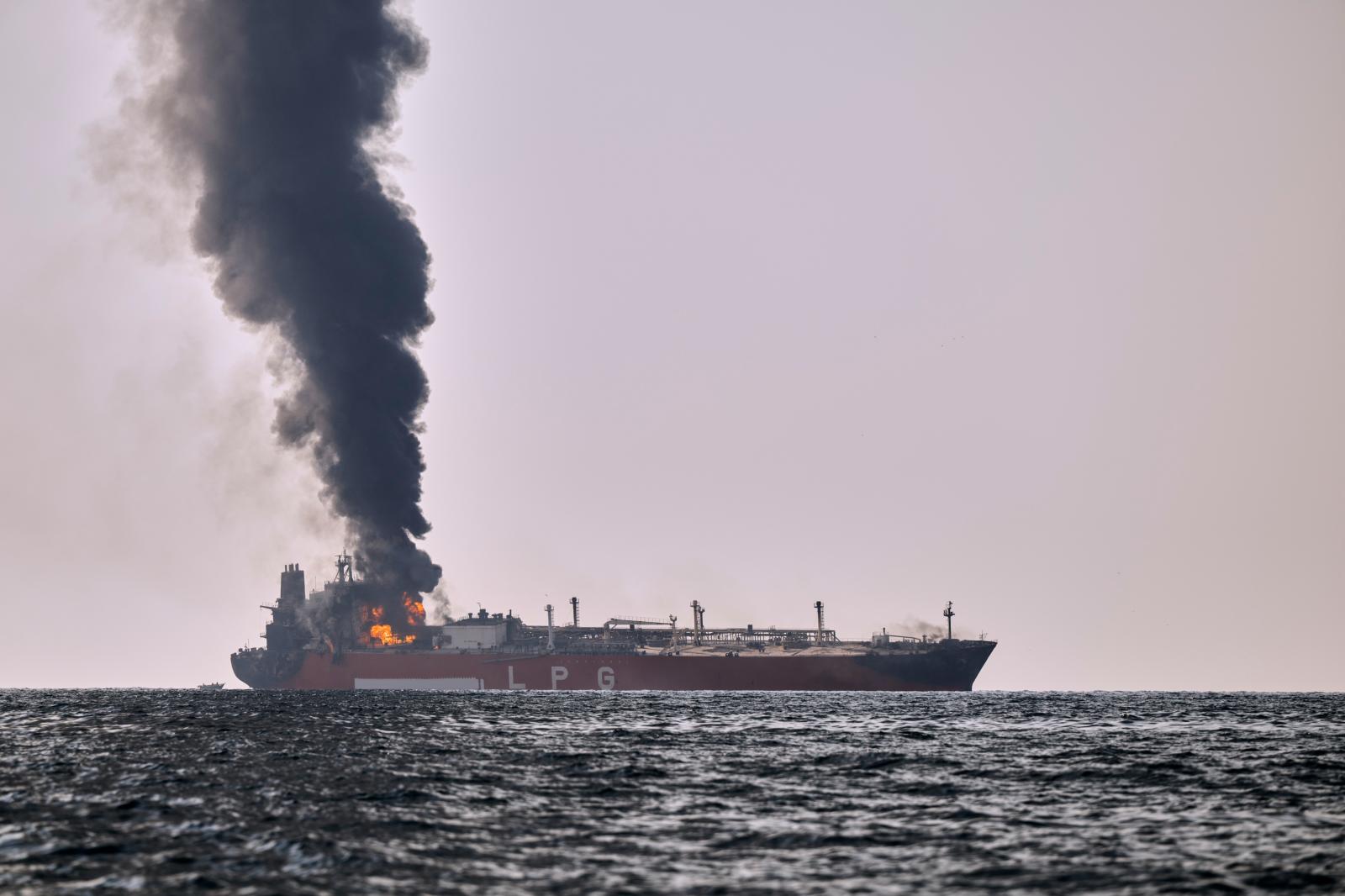
Two tankers were reported struck by unknown projectiles near Oman's Khasab on Saturday, the latest attacks in a wave that has turned the Strait of Hormuz into the world's most dangerous shipping lane.
The United Kingdom Maritime Trade Operations agency said an outbound tanker was hit on its stern about 11 nautical miles north of Khasab, and later reported a second tanker hit in its engine room about 17 nautical miles east of Khasab. No casualties were reported, and the environmental impact was unknown. It was not immediately clear whether the two reports involved the same vessel.
“Iran will never have a nuclear weapon ever.”— Donald Trump, president of the United States
The Details
Iran's navy said on Saturday that an oil tanker caught fire after hitting a naval mine in a restricted area east of the Strait. Reuters could not independently verify the Iranian account, nor establish whether it referred to any of the incidents reported by UKMTO. The mine claim remains a claim — and the two UKMTO reports may describe one ship hit twice, or two ships hit once.
The Saturday strikes extend a concentrated wave. On Friday, a tanker was hit near Khasab and caught fire — the fourth struck off the Musandam Peninsula in three days. The worst came on November 17, when the tanker NAVIG8 MESSI was struck 13 nautical miles north of Khasab and caught fire; ADNOC confirmed one crew member missing and 11 injured. The LPG tanker TARA GAS was disabled by a strike on November 16 and hit again the next day, catching fire a second time; 24 crew were rescued and one Indian seafarer is still missing.
More than 120 commercial vessels have been attacked in and around the Strait since the war began in late February, killing at least 24 seafarers, according to the International Maritime Organization. October saw 28 attacks, the highest single-month total. Analyst Martin Kelly of Orbital Risk Intelligence counted 15 attacks and piracy-related incidents in the past seven days — a 50 percent increase from the previous week. Traffic is now about 65 percent below pre-conflict levels.
How We Got Here
The attacks come as the United States and Iran fight a war that began on February 28, and as Washington's naval blockade of Iranian oil exports, expanded on November 18, squeezes Tehran. Iran has imposed restrictions on vessels passing through the Strait and attacked ships it says violated them. The Strait carried nearly one-fifth of global crude oil before the war.
Iran is preparing a challenge to the blockade. More than a dozen Iranian oil tankers have gathered near Kharg Island, the country's principal oil-export terminal, and Iran's state-affiliated Fars News Agency has floated a tanker convoy through the Gulf of Oman. The United States has struck Iran's Qeshm Island repeatedly this month, while Iran has lobbed drone and missile strikes at Kuwait.
Why It Matters
Trump faces calls from inside and outside his administration to resume major attacks on Iran paused since the summer, the Financial Times reported. Israel's ambassador to the United States, Michael Leiter, told the New York Post this week that his country "believes ousting the Tehran regime is now the only long- or even medium-term answer", adding that Israel "will not hesitate to go it alone". He later clarified that only the president decides when and where American troops are deployed.
At the same time, US Central Command has warned officials about the strain a prolonged military buildup is placing on American forces — "running out of time, burning money and readiness", a source told the Financial Times, though a US official disputed that. Congressional Democrats, who take control of both chambers in January, are preparing to challenge funding for the campaign.
Trump accused Iran on Friday of refusing a deal acceptable to Washington. "They want to make a deal, but they don't want to make a deal that's acceptable to me. We want to make a real deal," he told reporters. He repeated his vow that "Iran will never have a nuclear weapon ever".
What Happens Next
The immediate question is what hit the tankers — and whether Saturday's incidents were one ship or two. UKMTO's next advisory will settle that. The larger question is whether the attacks push Trump to resume the major strikes the hawks demand, or whether the strain on US forces and the coming congressional fight over funding keep the pause in place. The Joint Maritime Information Center still rates the threat to shipping in the Strait as SEVERE, and further attacks are considered highly likely.

Loading comments…