
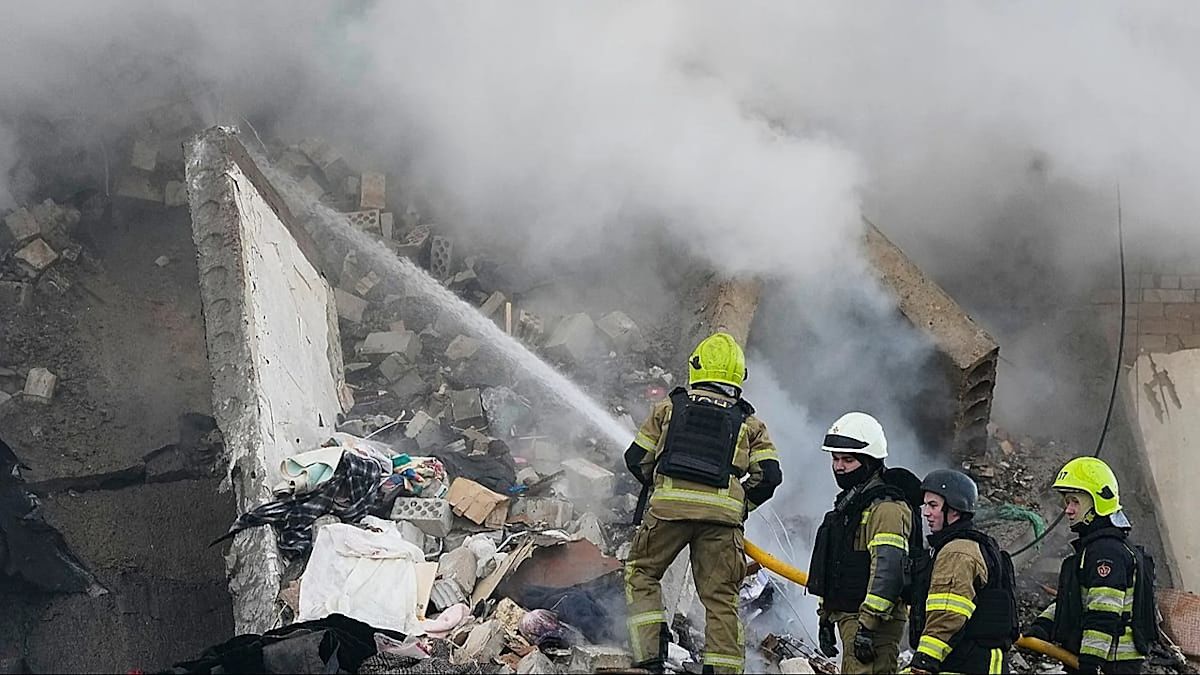
A Russian drone strike destroyed part of a five-storey apartment building in Dymer, in Ukraine's Kyiv region, on Sunday morning, killing two people and leaving 15 missing, including two children, Ukrainian officials said.
Rescuers were still searching the rubble on Sunday as emergency crews worked to find survivors, with officials warning that people could still be trapped beneath the debris.
“Part of a five-story apartment building has collapsed following a Russian drone attack.”— President Volodymyr Zelenskyy
"Part of a five-story apartment building has collapsed following a Russian drone attack," President Volodymyr Zelenskyy said on X. "I thank our first responders for acting quickly: nine people have already been evacuated, and the fire has been contained."
The Details
The strike hit a section of the building in Dymer, a town in the Vyshhorod district north of Kyiv, destroying apartments across all five floors and sparking a fire. A nearby kindergarten and a shop were also damaged, according to the Kyiv regional administration.
Two bodies have been recovered from the rubble, Timur Tkachenko, head of the Kyiv Regional Military Administration, said. The death toll rose to two after emergency crews recovered a second body during the search.
Four people were injured. A teenager was hospitalised with multiple shrapnel wounds to an arm, a man was hospitalised with a suspected closed head injury, a 22-year-old woman was treated at the scene for cuts to her foot, and a woman was treated for an acute stress reaction.
Ukraine's National Police said 15 people were listed as missing, including two children: an 11-year-old girl and a seven-year-old boy. Zelenskyy, in his own statement, said at least 14 people may still be trapped under the rubble.
Emergency service footage showed rescuers searching through a large pile of rubble, helping residents descend from the damaged building by ladder and crane platform. Authorities set up a coordination centre in the shelter of a local kindergarten, bringing together social services, volunteers and psychologists to help affected residents. Food was being organised for residents and rescue workers, and plastic sheeting and building panels were distributed to protect homes with less serious damage.
How We Got Here
The Dymer strike came at the end of a week of heavy Russian attacks across Ukraine. On Sunday, Zelenskyy said Russian forces had launched around 2,700 drones, close to 1,460 aerial bombs and 165 missiles at 20 Ukrainian regions this week.
"A significant number were ballistic missiles, including North Korean ones, which the Russians are constantly helping Pyongyang modernize to improve their accuracy," Zelenskyy said, as he renewed calls for allies to speed up deliveries of interceptor missiles.
"It is particularly difficult to understand the delays in supplying anti-ballistic interceptors to Ukraine," he added, urging Washington to authorise transfers of interceptors already paid for through NATO's PURL initiative.
Days earlier, Russian forces fired more than 400 attack drones and over 110 missiles at Ukraine from Thursday night into Friday morning. Zelenskyy called it "one of the largest attacks" of the war so far. At least seven people were killed in Kyiv in those strikes, while key bridges across the Dnipro River were also damaged.
Ukrainian forces also carried out their own strikes overnight, targeting a Russian National Guard facility in an attack on Krasnodar. Five people were reported injured in the strikes on the region, including four in Afipsky, a settlement home to an oil refinery that has previously been targeted by Ukraine.
Why It Matters
The Dymer strike shows how the war's toll falls on ordinary neighbourhoods far from the front lines. The building that was hit was an ordinary five-storey apartment block; the kindergarten next to it, where the coordination centre now operates, is where local children go to school.
The rescue operation is also a race against time. With 15 people unaccounted for and officials warning that more may still be under the rubble, every hour of searching matters — and the figures are likely to change as the operation continues.
The attack adds pressure to Zelenskyy's plea for faster air defences. His call for Washington to authorise interceptor transfers already paid for through NATO's PURL initiative puts the question of air defence supplies at the centre of Ukraine's diplomacy with its allies this week.
What Happens Next
The search-and-rescue operation in Dymer was continuing on Sunday, and the death toll and the number of missing are expected to be updated as rescuers work through the rubble. The regional administration said the operation would go on until every part of the collapsed section had been searched.

Loading comments…