
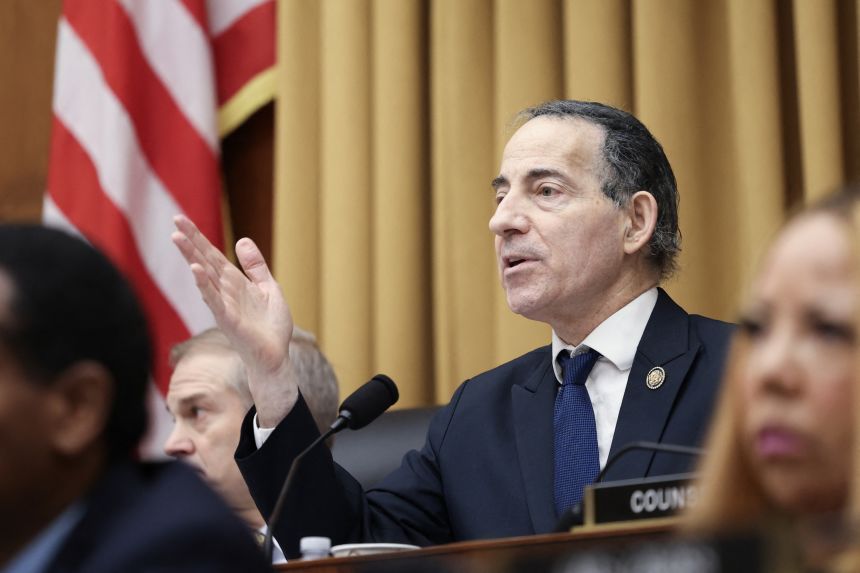
A top House Democrat accused the Trump administration of destroying government records, and demanded five law-enforcement agencies stop using apps that delete their own history. The letters, sent Wednesday and made public Friday, set up a showdown over what the next Congress can investigate.
Representative Jamie Raskin of Maryland, in line to chair the House Judiciary Committee in January, wrote to the Justice Department, the FBI, Homeland Security, Immigration and Customs Enforcement and the Bureau of Prisons. In the letters, he wrote that there is "significant evidence" of "widespread destruction, mutilation, and concealment of government records" to circumvent federal preservation laws.
“There is significant evidence that Trump Administration officials have engaged in the widespread destruction, mutilation, and concealment of government records.”— Rep. Jamie Raskin, Democrat of Maryland
The White House is not cooperating. A White House official told CNN that "we comply with all federal record retention laws and regulations," and White House Counsel Will Scharf wrote on Wednesday that the administration will refuse oversight demands from the minority party — because Democrats do not yet chair the committees.
The Details
The letters rest on one piece of evidence: a screenshot of a Signal conversation Raskin says his committee obtained. It shows the FBI's top lawyer, General Counsel Samuel Ramer, exchanging messages with Drew Lynch, a producer for Donald Trump Jr.'s podcast "Triggered." The conversation was set to auto-delete after a week, and concerned "a potential or ongoing investigation involving an individual wanted by federal authorities on health care fraud and related charges."
According to the Washington Post, Lynch shared a letter from Eric Deters, a Kentucky businessman, to FBI Director Kash Patel dated June 24, 2025, urging action against a former Ohio surgeon who fled to Pakistan after a 2013 indictment for unnecessary surgeries.
Raskin called the exchange "one of many" reported to his committee. Writing to Attorney General Todd Blanche, he said: "The FBI's top lawyer should be ensuring that all 35,000 FBI employees are preserving government and law enforcement records. Instead, he has conducted official business on a platform specifically configured to erase communications." He asked the department to try recovering deleted messages from backups or "associated metadata."
The Federal Records Act requires agencies to preserve communications documenting official business — even on personal devices or apps like Signal, WhatsApp and Telegram. Signal offers end-to-end encryption and lets users set messages to delete automatically.
How We Got Here
On Wednesday, Representative Robert Garcia of California — the incoming chairman of the House Oversight Committee — sent 12 preservation letters to Vice President JD Vance, members of the Trump family, chief of staff Stephen Miller, Attorney General Blanche and others. Garcia's targets are alleged Trump-family profiteering, misconduct at Homeland Security and a White House cover-up of the Epstein files — a story already on this site. Raskin's letters are a separate front: not the Trump family's business, but the government's own records.
The administration's answer to both sets of letters has been the same. Scharf wrote that the requests "all drip with an animus or pettiness revealing that the purpose of these letters is not legitimate oversight but to harass and aggrandize." Refusing oversight demands from the minority party was a policy adopted in Trump's first administration and later embraced by Joe Biden's White House. In response to Garcia's letters, spokeswoman Lauren Bis said: "If Democrats choose to pursue sham investigations and radical left policies, they are choosing to work against the American people."
Why It Matters
The letters have no legal force; no one must hand over documents. Their purpose is to put recipients on notice — and to create a paper trail. As Jim Secreto, a former Obama White House Counsel's office lawyer, told CNN, the letters are Congress "drawing a line in the sand" so that anyone who destroys records "could potentially be prosecuted in a future administration for obstruction of Congress."
That is the real stake: in January, Democrats take Congress and with it subpoena power, and if the records of the last two years have been deleted, their investigations start blind. Raskin will chair Judiciary and Garcia Oversight, and both plan far-reaching investigations — into the Trump family's business, the Iran war, the Epstein files and the agencies themselves.
What Happens Next
The agencies did not respond to requests for comment. Raskin says there are more reports to come — the Ramer screenshot, he wrote, is "just one of many." The next test comes in January, when Democrats take the gavels and the letters turn into subpoenas. Until then, the White House's position is clear: it owes the incoming majority nothing.



Loading comments…