
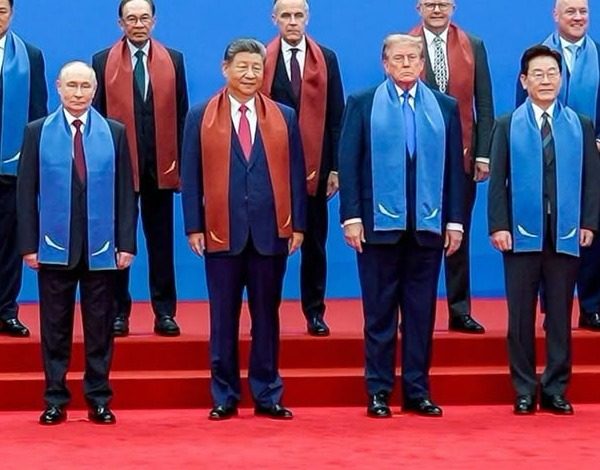
President Donald Trump, Chinese President Xi Jinping and Russian President Vladimir Putin held the first-ever trilateral meeting of the leaders of the world's three largest nuclear powers on Thursday in Shenzhen — and emerged 90 minutes later with a joint declaration nobody in Washington had predicted.
Hours before the talks, a senior U.S. official was blunt: "We do not expect to get to any kind of agreement." The meeting was billed as a first conversation, not a negotiation. Instead they adopted a four-point "peace declaration" on UN reform, energy, the ICC and nuclear weapons — then Trump boarded Air Force One and flew home within the hour.
How We Got Here
The summit was the Russian leader's idea. Putin first proposed a three-way meeting on the sidelines of the APEC forum as a venue to discuss ending the war in Ukraine, and Trump eagerly agreed. The White House confirmed the meeting on November 13; China's foreign ministry confirmed it three days later.
The staging was elaborate. Xi personally greeted Trump on the tarmac when he landed in Shenzhen on Wednesday — the first time a Chinese president has received a foreign leader at the airport — and arranged a military flyover. That evening the three men shook hands at the APEC welcome banquet, the first photograph of them together.
Thursday began with separate bilaterals. Trump and Putin met one-on-one for about 40 minutes, their first face-to-face talks since the Alaska summit in August 2025 ended without a deal on Ukraine. Trump embraced Putin as they greeted reporters and called him "my friend." His meeting with Xi lasted about an hour, dominated by trade, technology and farm purchases.
Then the three men walked together into Kylin Villa, a lakeside government guesthouse in Shenzhen, and sat around a large round wooden table under a towering Chinese landscape painting. Xi sat in the middle as host, Trump to his left and Putin to his right.
What the declaration says
The four-point text, published by the Kremlin, commits the three countries to reforming the UN so it can "respond more effectively to global challenges," to increasing production and supply of refined petroleum products, and to a dialogue on reducing nuclear risks and preventing proliferation. Its central line: "a nuclear war cannot be won and must never be fought."
The most pointed passage concerns the International Criminal Court: the three leaders agreed the court and similar bodies "must not abuse their jurisdiction." The ICC issued an arrest warrant for Putin in 2023 over the alleged deportation of Ukrainian children, and it remains in force. Trump, sitting across from him, called the court "out of control."
“We are really making history.”— President Donald Trump, opening the trilateral meeting in Shenzhen, Nov. 19
Xi used his opening remarks to call for "every effort" to prevent nuclear war and to uphold the nuclear non-proliferation treaty. Russian state media reported he also called for a complete ban on nuclear weapons. Trump, opening the session, said the three countries were "uniquely positioned" to discuss nuclear weapons — and admitted the hard part: "Once you have the nuclear weapons it's very hard to not have them."
Why It Matters
The meeting matters less for what it settled than for what it displayed. The three leaders control the world's three largest nuclear arsenals, and New START — the last treaty capping American and Russian strategic weapons — expired in February, leaving the two largest stockpiles uncapped for the first time in more than half a century. A first conversation between the three is, by itself, a new fact.
It also matters for who was not in the room. Ukraine's President Volodymyr Zelenskyy warned the meeting could become a "new Yalta" — a carve-up of the world by great powers at smaller countries' expense. European leaders doubt Putin is serious about ending the war, and France's foreign minister dismissed the summit outright, saying the three leaders "fundamentally disagree on everything."
Trump pushed back, saying no peace was ever forged "by refusing offers to speak." On Ukraine he sounded optimistic — "things are happening," he said after his talks with Putin — and hinted he sees Zelenskyy, not Putin's demands, as the obstacle.
What Happens Next
The declaration promises dialogue on nuclear risks, but sets no date, no venue and no negotiators — and China has long resisted joining U.S.–Russia arms talks while its arsenal is far smaller. Whether the 90 minutes becomes a process or a photograph depends on what the three governments do next — and none of them has said.
For Trump, the trip ends where it began: flying home to a Democrat-controlled Congress, a December 11 funding deadline, and a fight over funding the Iran war. The history he made in Shenzhen will be judged against what happens in Washington next.
© 2026 Capitol Wire Daily. All rights reserved. Capitol Wire Daily reports facts from official statements and verified reporting; developing stories are labeled as such.


Loading comments…